Saturday, October 20, 2012

Thoughts on fun...


For all ages

What is fun?

It's funny, most of my blog posts begin with a similar question and now I'm talking about something unique and relative to any person on the planet. Fun is not something that can necessarily be quantified or understood on the same level by everyone. What may be fun for one person might not necessarily be fun for someone else. With a plethora of definitions and explanations by psychologists and theorists of every shape and size, fun has a lot to do with every man, woman and child's personal emotions and attachment to a recreational activity or social interaction.

Enough with the formalities then, what about fun in terms of jokes or gags?


The joke's on you

You may have heard of the common phrase "Oh, I was just having a bit of fun is all!" The saying is synonymous with apologetic smiles and practical jokes ended on a bad note. So this brings up the idea that not all fun is relatable on every spectrum. Carefree and light-hearted people often take gags and jokes well, while others don't seem to have as much fun at another's expense. Here's something to keep in mind throughout this discussion, not everyone will perceive fun the way you or I do. People were made different and hence we all react the way we see fit and what comes naturally.

In today's world, it is common to turn on the TV and watch someone or the other "poking fun" at someone else. Television shows like MadTV and SNL are famous for such antics, often disgracing celebrities and politicians in the process of making people laugh for a living. The media is heavily populated with ideas of fun and entertainment to amuse the masses. So what about the fun in games? How does fun play into the design of games for entertainment? Is it necessary for games to sustain an element of fun? Who decides what is fun and what isn't? Let's take a closer look a fun in games. 


I'm board of games

For decades, the challenge of overcoming obstacles has been moving games forward and redefining fun for generations of people. Deciphering patterns, studying methods and figuring out brain-teasing puzzles has been the goal of board games and, in many cases, the winning conditions for any kind of fun in a game. I've always believed that fun comes out of being able to escape from reality and enter a world where the sky is your limit and your imagination is set to run free. When an obstacle is presented, tools are given to overcome it, so games must be built to help us problem solve. Overcoming mounting odds often increases dopamine levels in our brain, which we relate to the concept of having fun. Knowing that our reward is fun, we continue to push ourselves and try our best making challenges in board games our own way of having fun.

Nicole Lazzaro's 4 types of fun help define engagement within games and why human enjoy playing games on an individual and often social level. 

The four types of fun:
  • Hard Fun: This fun is associated with challenges and the player's ability to master patterns and overcome obstacles for rewards of personal accomplishment. An Italian word, Fiero, is used in relation to hard fun. Fiero translates to pride in triumph over adversity. 
  • Easy Fun: This type of fun focuses on the curiosity of players by introducing exploration, role playing and story-telling. It enhances a player's experience by taking him/her out of their regular lives and immersing them in rich new content that has yet to be discovered and unraveled. 
  • Serious Fun: This fun is all about gaining valuable skills that may be applied to real life situations. Often the player feels a certain excitement from the thrill of learning practical skills.
  • People Fun: The most interactive of the 4 types of fun, People Fun has to do with social activity between peers and team work when playing games. This type of fun is the reason friends hang out with one another and choose to spend time in a group of like-minded individuals. 


Therefore, the more you play, the more you learn and the more you gain in the long run. Children are encouraged to play at a young age to learn about the world, to explore, interact, be challenges, overcome their challenges and learn life lessons. This is a summary of what Mrs. Lazzaro was trying to explain through her description and classification of fun. 

Albert Einstein once said, "Play is the highest form of research." I believe that Einstein was trying to get at the fact that nothing is truly learned or understood until it is put into play in our lives. We learn when we have fun and we have fun by engaging our senses and stimulating our brains. For this reason, some games, often referred to as 'Infinite Games' are made and played with the purposeful intention to "keep playing" (James P. Carse).


Survival of the fittest

An interesting topic was brought up in discussion about what cavemen did to survive and how their activities, all these years later, are now considered to be fun in our eyes. The idea that the basic human primitive needs to acquire territory, hunt and gather, collect and supply, are still alive today in the games we play and in what we consider to be fun. So then maybe this concept of fun comes from a native need to survive. Maybe the challenge of learning, adapting and discovering has become a form of entertainment and perhaps the way we begin to see our daily activities as primitive in our understanding of survival. What I'm getting at here is that we have become so accustomed to having all we need within our reach that we have forgotten how our ancestors used to do it. This prospect of struggling to survive peaks our interest maybe even on a subconscious level. 

During the prehistoric age, men would fight for land, food and women. The survival of the fittest was a reality understood and realized by our ancestors. But are we so different today? A lot of us perceive fun to be conquering another on a playing field whether real or metaphoric. Competition is a major form of fun, even after all these years. Thinking about it makes me realize that perhaps our perception of what is fun hasn't really changed much from what our ancestors considered it to be. We learn patterns which we apply to our everyday lives on a subconscious level and we feed our curiosity through the prospect of exploration and education.

But if we've been given a pre-determined understanding of what fun really is, then how do we know we're having fun and how abstract can fun get?


Art Games

The purpose of an art game is to explore an idea or a concept in a unique and interesting manner. Every game is left up to the interpretation of the player and usually there are no rules except for those the player decides. So are art games fun?

Art games might not be considered by most as fun, but if they manage to provoke thought within an individual and maybe help them see more than simple frustrating gameplay then they have fulfilled their purpose. Sometimes, art games are created to express the creator's feelings or attitude towards certain concepts or institutions. Take 'The Marriage' by Rod Humble, for example, while bluntly open for interpretation, many people begin to see similarities within the gameplay and how the game elements react with one another. This could be dependent on an individual's marital status or even their  cultural background. Since fun is relative then, some might consider 'The Marriage' to be fun. There is a certain amusement that comes out of self-discovery and exploring ideas beyond the norm. The beauty of art and the interpretation that comes with it, may be considered by many to be 'Easy Fun' one step away from 'People Fun' which comes with exploring art in the form of an experience that may be shared with others. 


Conclusion

Fun comes in many shapes and forms and is different for every individual on Earth. What may make a game fun for one person, may make the same game challenging for another or frustrating for someone else. Some people enjoy the thrill of learning, while others find fun in interpretation and discovery. Whatever your definition of fun, at the end of the day it makes us who we are and helps us grow as we learn and apply ourselves in all aspects of our lives.


Tuesday, October 16, 2012

Liar's Dice


Liar, liar

What is Liar's Dice?

Liar's Dice is a game with simple rules that may be played with 2-6 players (depending on the number of dice available). The game plays out based on a player's ability to lie or hide the truth and to make smart calls and possible bluffs. The rules are simple but gameplay is fun and never fails to entertain and amuse. The game is usually more fun when played in a large group of friends, especially when behavioural patterns are easily identifiable and poker faces aren't the greatest. The basic premise of liar's dice revolves around placing 5 dice in a cup, shaking the cup and laying the dice out so that they are only visible to you. Now the other players must do the same and call dice hands appropriately based on what they may or may not have. If that seems convoluted, let me break it down a little further.

Rules:

A player places five dice in his/her cup and rattles them vigorously till satisfied placing the cup face down with the dice underneath. 

Slowly lift the cup so that the dice are only visible to you.

Once all player have done as much, the last player to place down their cup call a dice hand: 1 - 5 face, 2 - 6 faces, 4 - 3 faces, etc.

The objective of the game is for each player to attempt to call a higher dice hand without being wrong and while playing his/her own hand as well as everyone else's.

If a player's bluff is called, he must reveal his dice as should every other player. 

If the player's call checks out (he/she attains the number of faces they have called) then the person who called his/her bluff loses a die. Otherwise, if the player's call doesn't check out (he doe NOT attain the number of faces declared) he/she loses a dice themselves. 

If a player at any point calls 'SPOT ON' (claiming that the number of dice faces announced is exactly how many there are among all players) which is found to be true - the number of faces doesn't go over or under the number of faces declared - all players, except the one who made the call, loses a dice. 

The winner, then, is the player left standing with the most dice after all other players have successfully been eliminated. 


Game Time

An average game of Liar's Dice - with basic rules and without any modifications - lasts anywhere from 15 minutes to half an hour based on the number of people and playing as well as the number of dice being played with.


Contents

  • 5 dice per person.
  • 1 cup per person.


Positive Feedback Loop

The positive feedback loop my group identified while playing the game was quite clear and obvious. As players call bluffs and spot-on's effectively, they are rewarded by not losing any dice. On the other hand, if a player lies or is unlucky enough not to have the hand declared among all players, then they lose a dice and as such, the game becomes harder on them. The way this feedback loop works is not necessarily by awarding players who are good at predicting hands or at reading players, rather, it punishes players who might not necessarily be good at such things by further taking away their amount of control in the game. The player with more dice clearly holds an advantage while the player with less dice is less likely to make a risky call. Even if they do, it becomes increasingly easier to call a player's bluff if they have less dice simply due to their lack of power in the game (the highest hand a player with one dice can call is 1 - 6 face).


Modifications

While playing Liar's Dice we came across many issues with the positive feedback loop and how effective it was in having fun during gameplay. As a result, we created a few modifications to change the way the game is played as well as the winning conditions in some cases. Here are the modification we tried and how they turned out. 

Mod 1: Pity Mod

The pity mod allows players with 1 dice to go down on their call by one tier. For example, if a player calls 4 sixes, should the next player be left with only one dice the may say 3 sixes or 4 fives instead of 5 sixes or higher. This mod may be in effect until only 2 players remain in which case the modification is negated.

The result of implementing this mod is that it allowed weaker players to remain in the game longer bringer other players down to their level and not necessarily rewarding players with more die. It reduces the positive feedback loop by a reasonable amount. 

Mod 2: The Flop Mod

For this mod, the game is played as per usual, except that the lost die get placed in the center of the table and are rolled on each turn for everyone to see (almost like turning over the flop in poker for everyone to see). The dice count toward the total number of dice faces. 

After implementing this mod, we realized quickly that the modification doesn't really do much to affect gameplay. Every call is made keeping in mind the dice in the middle being rolled and since all players can see all the dice, there really isn't much of a challenge or change in having them rolled and considered to be part of the total number of faces on each turn. Players who were good at counting dice had an advantage and did even better. It may be considered to be reinforcing the feedback loop in certain ways, but in my opinion it really doesn't do much to change gameplay or the feedback loop much. 

Mod 3: Loser Wins Mod

Through this modification, the loser is the person with the least dice by the end of the game. Should a player accurately call a bluff or make a correct call, they lose a dice while everyone else holds on to their dice. Calling a bluff incorrectly loses the person the bluff was called on a dice. A precise 'SPOT ON' call loses a dice to the player making the call, while all other players hold on to the number of dice they currently have. Calling a 'SPOT ON' incorrectly gains the player making the call a die. 

This mod worked particularly well in reversing/removing the feedback loop specifically due to the fact that losing a dice makes it more difficult to play the game. Therefore, players who are particularly good at making calls will find it more difficult as they progress since less dice equates to a loss in power within the game. This also gives all other players a fair advantage over the player doing particularly well. This mod institutes the idea of difficulty in progression, causing the positive feedback loop to be replace by a negative feedback loop instead.


Mod 4: Handicap Mod

This mod causes every player who has not lost a die in any particular round (except the first, of course) to reveal one of their dice in the next round. This is only held true should the player have 2 or more dice. A player with one die does not have to reveal this die to keep things fair. 

We particularly enjoyed implementing this rule due to the fact that it doesn't matter whether or not a player is good at making calls or calling bluffs, the advantage in the next round goes to players who have lost dice in the previous round. As a result, players who prefer to remain silent during gameplay or refuse to make calls are punished by almost losing a die. This, in turn, hinders the positive feedback loop but does NOT remove it completely. 

Mod 5: Lucky Charms Mod

With this mod implemented, players who have call a successful 'SPOT-ON' may reacquire a lost die up to a maximum of 5 dice to play with (the amount you began with). Other players will still lose one die if the call is successful and other rules are applied as per normal. 

Our initial idea behind the implementation of this rule was to encourage players to take the risk of calling 'SPOT-ON' which is harder than expected. If a player with a low number of dice manages to call it successfully, they will be rewarded for their accuracy. However, we soon also realized that this rule further enhances the positive feedback loop by rewarding players for doing well in the game. While this rule does do a good job of balancing out the positive feedback loop by giving equal reward to someone with a low number of dice, it gives players with greater numbers of dice a further advantage over everyone else. 

Mod 6: Blind Mod

By far the most fun mod to play with, the Blind Mod states that a player may see everyone's dice but their own. This makes the game far more interesting and strategic on another level. When the dice are rattled and laid down, the player must point his/her own dice away from themselves and block it entirely from their view while making sure their own dice are clearly visible to everyone else. They must then take a look at all other players' dice and make calls based on what they see. 

We learned quickly that playing the game with a small number of people greatly increases the challenge in playing Liar's Dice with the Blind Mod. The less dice a player has, the harder it is for someone with more dice to make a call. On the other hand, players with more dice find it more of a challenge to call hands based on less dice. This rule entirely reverses the positive feedback loop as the winner gains no reward for a successful call. This is by far the most fun mod to implement and leads to hours upon hours of good family fun!


Conclusion

Liar's Dice is a lot of fun to play with several modifications if implemented well. The premise of the game is straight-forward and the winning condition is quite simple. The only real thing to keep in mind when playing with the above modification is that some games may be played with one or more modifications but no game, in essence, may be played with all modifications. The reason for this is that some mods simply negate others and on attempting to play with all modifications implemented in one game, we quickly lost interest in the game and decided to play with 2 or less mod implemented in one game. This game was played with 6 people during playtesting and it was determined to be a hoot! 

Liar's Dice + modifications = Innovative Innovators Seal of Approval!


Sunday, October 14, 2012

Assassin's Creed


Reading between the lines


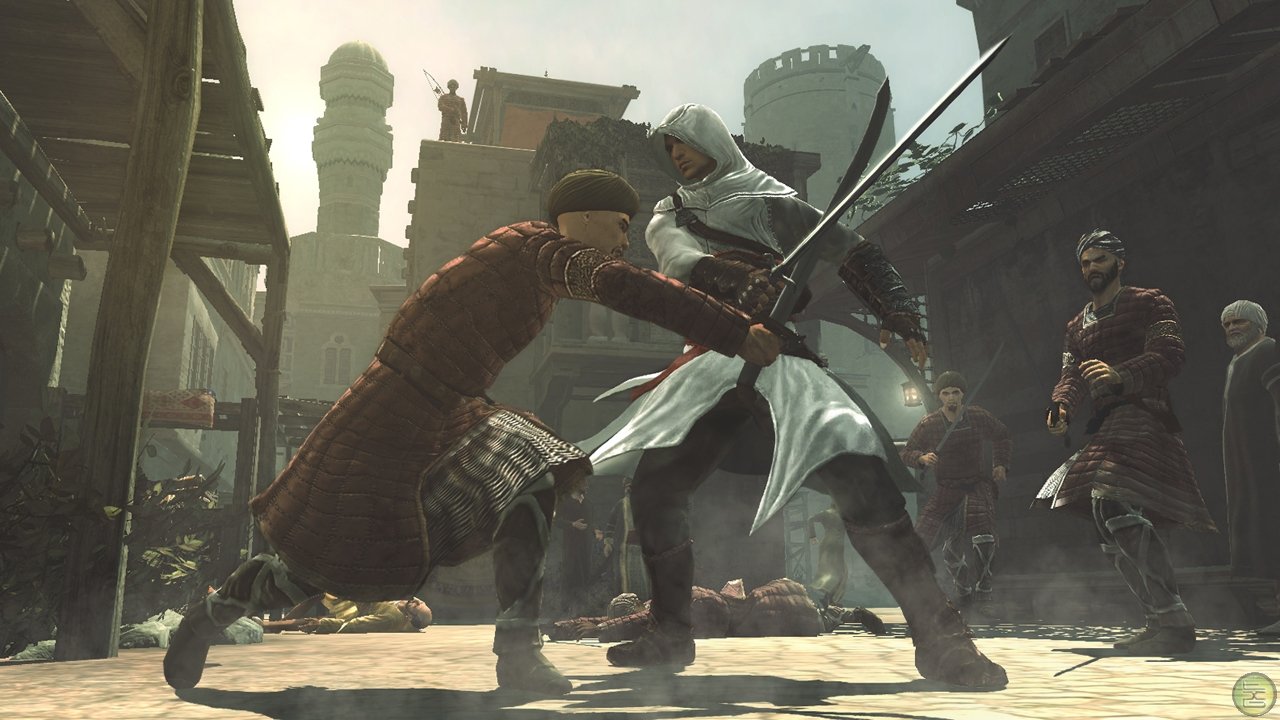
Assassin's Creed is a beautifully crafted action/adventure title developed by Ubisoft Montreal. The game's most standout feature is the stealth mechanic implemented to blend seamlessly with the rest of the game world which is set during the Third Crusade in the Holy Land. The characters, environments and animation simply gel together to form a fast-paced stealth combat game centering around deception and a skillful protagonist who is more than he seems. This article will cover the manner in which interpolation plays a role in the crucial animation of this smooth and natural flowing stealth title. Even though it has been years since it's release, Ubisoft certainly hit a benchmark with the creation of such a smooth flowing sandbox-style gaming dynamic, one which continues to impress players all around the gaming world.


A Creed to Live By

Assassin's Creed is centers around Desmond Miles, a bartender who is extracted from his normal life and made to relive the memories of one of his ancestors through the use of a machine known as 'The Animus.' Desmond slowly begins to realize that his ancestor is an assassin known as Altair who found himself in the midst of a battle between two ancient sects: the Knights Templar and the Assassins. Both sects are after a rare and powerful artifact simply referred to as a 'Piece of Eden.' Now it is Desmond's job to accurately relive his ancestor's memory and to travel from city to city in search of powerful enemies who must be eliminated before they cause further damage in history.

For the full story on Assassin's Creed as well as more information on all other games in the series, click here


Interpolation...an overview

Throughout the vast cosmos of Assassin's Creed, interpolation is used as a creative tool to immerse the player in a world of fantasy and a living, breathing, environment considered to be Altair's playground. Cut scenes, Enemy AI, Combat and even simple title animations all make use of interpolation as a primary animation mechanic to create an astounding game world with a striking protagonist at its forefront. 

So now let's begin with AI (Artificial Intelligence). 


In Assassin's Creed, enemy AI plays an important role in core gameplay mechanics as well as character progression through combat. In order to progress, you must assassinate and once a target is assassinated, it is inevitable that you must be chased down by guards. Now, whether Altair runs away and hides, or faces a steady stream of guards all at the same time, is entirely up to the player, but guards will be around nevertheless. In order to create an atmosphere of anxiety for the player at all times, guards prowl the streets and are just around every corner. Furthermore, they block crucial passageways and harass citizens exploiting behavior that tends to tease the player's conscience. When left alone, enemies walk a pre-determined path getting from one place to another through the use of splines, more specifically, Catmull-Rom splines. This is most notable as they weave in an out of crowds and turn around to follow the same basic path (possibly outlined by specific points behind the scenes) as they pace back and forth in search of trouble. 

Crowds work similarly as do most townsfolk. Every character imbued with Artificial Intelligence has a pre-determined path within the gameplay environment. Simply walk into a marketplace and watch the fantastic A.I. at work as every NPC navigates through the city with ease, managing to accurately represent the hustle and bustle of everyday life in the Holy Land. Certain NPCs have different characteristics such as the monks who flock together and have people (including guards) move out of their way as they pass through the city. Such groups also retain a pre-determined path, rarely veering off unless harmed by Altair. If a citizen is harmed in any way, they die on the spot, stand still complaining of their misfortune, or continue to interpolate along the path they had been on.


Altair manages to skillfully steer through crowds without knocking them over when in stealth mode. Since the point is to remain off the radar, Altair will walk slowly and carefully interpolating to the path determined by the player as he moves the joystick and new points are formed for Altair to interpolate between. If characters cross interpolating paths, what commonly happens is that Altair will squeeze between them or softly nudge them aside as he steps through the throng of citizens. Very noticeably, Altair's clothing matches that of the flock of monks walking through the streets of the city. As such, the assassin may blend in with the group to stealthily get passed guards to simply avoid confrontation and unnecessary combat. 


The Holy Land

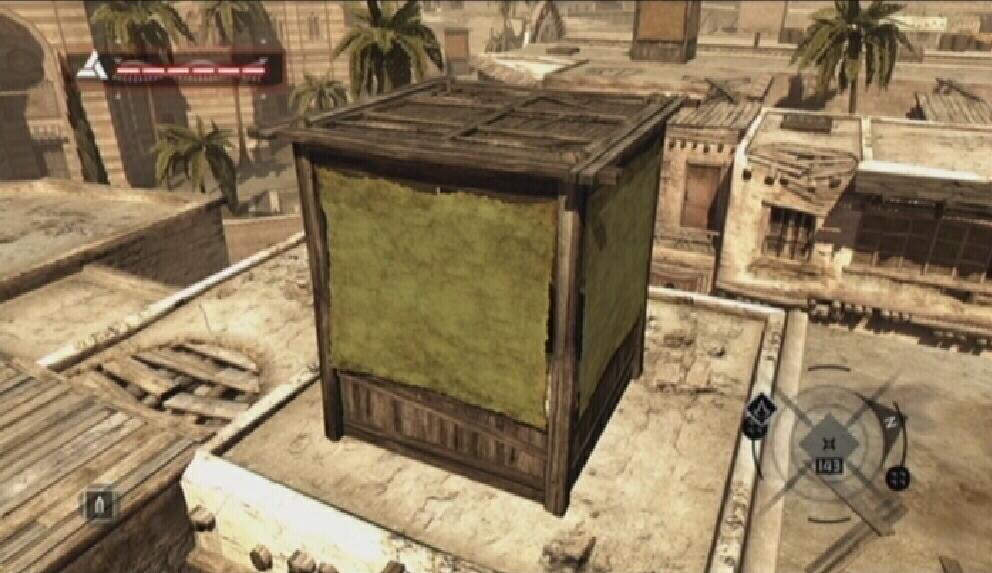
Throughout the game world, Altair can interact with certain objects just by walking into them or knocking them over. He is excellent at walking right into certain objects such as baskets, oil lamps, houses and people. As such, upon interacting with these objects they interpolate from one position to another in the game world. I'm not talking about a drastic interpolation like kicking a barrel across the city, rather it's the small motion that is a lot more noticeable and adds to the splendor of the well-designed game world. A good example would be the manner in which a hanging lamp simply swings from place to place when Altair happens to knock an enemy over into it. It is quite clear to see that such objects have been programmed to interpolate in small increments to replicate real-life reactions to object interaction. 


Another thing to notice is the way pots drop from the arms of women balancing them on their heads. When Altair nudges a woman with a pot, the pot simply seem to linearly interpolate right to the ground with minimal rotation and smashes almost immediately so all the player notices is a smashed pot and a woman complaining about you ruining her livelihood.  

Trees and bushes in the environment sway with the wind. As such, it is each to see how they might be created using nodes which interpolate between points on a pre-determined path when an element such as wind is introduced. This can also be the case when Altair happens to walk through these objects in the environment. The points of interpolation change when these environmental objects are interacted with. Flags, tapestry and carpets all interact in a similar manner when wind is brought into the picture. It is quite amazing how to see how interpolation along a Bezier curve can cause objects like tapestry to ruffle in the wind or due to player interaction. 


Cut scenes

The cut scenes and trailers from Assassin's Creed are littered with camera interpolation here and there. The basic camera in most cut scenes follows a spline path which pans around a centrally focused area that is staged for the player to see. When ever Altair climbs up a landmark, there is a short cut scene where the camera pans around the city in order to reveal new areas on the map. It seems as though the camera is following a spline path to get the view of the entire city as Altair scans up to the horizon. 

A great example of camera interpolation can be found in the trailer of the game where the camera performs linear interpolation moving quickly from one area to another in a short amount of time. It zooms in and out on the same scene making it seem as though it may be interpolating between several area in one scene to portray the most significant moments in the trailer and to stress the stealth and speed elements within the game. There are also moments when the camera interpolates after Altair as he navigates the environment in escape from the guards attempting to arrest the assassin. 


The Assassin

Altair's movements are easy to be perceived as interpolation from one area to another. This is especially noticeable when the assassin is navigating the environment and assassinating certain targets.


Altair can scale walls and buildings by grabbing on to certain 'sweet spots' as he makes his way up. He pulls himself up on to beams and ledges slowly navigating the length of the construction (usually a tower or building). It is plain to see locomotion in his movement, however, interpolation is even more clear in Altair's steps from one ledge to another. It simply seems too linear. Although the motion is genuine and accurate, it is easy to notice that the assassin is simply interpolating from one spot to another as he is animated in different positions. 

Another neat manner of interpolation is Altair's ability to execute a jumping kill. When close enough to an enemy, Altair will leap forward and interpolate right on top of the enemy who will immediately drop to the floor as he is impaled with a hidden blade. This tends to replicate Catmull-Rom quite a bit as the player can tell that Altair is simply interpolating along a cubic spline curve from one specific point to another in 3D space. 

Free-running by holding down a certain combination of buttons (depending on the console) helps Altair to run in one specific direction along a path that is being drawn out as he goes. Once in sprint mode, he begins to run straight and then quickly interpolates to a different path depending on the direction of joystick movement determined by the player. In a free-run it is easy to see that the player does not have complete and accurate control of Altair which is accurate to real life where moving at such a fast speed reduced the accuracy at which someone can control the intricacies of their maneuvering movement. At these points, the player may notice the varied spline paths Altair may veer towards to continue forward while remaining in a sprint. 


Even combat takes a clear stab at interpolation as Altair's subtle movement from one position to another while intricately aiming his sword and planning out his attacks are a clear indication as such. Every time Altair is knocked back he interpolates backwards linearly while each strike interpolates him forward to a new position. The enemy A.I. works the same way until they are killed. 


Last Words

A lot of movement in the game can be seen as interpolation from one point to another. This is especially true in the superbly animated faces of the protagonist and all NPCs scattered throughout the Holy Land. It is most noticeable when Altair is engrossed in conversation with another character or when someone (such Al Mualim) is giving him instructions. 


Furthermore, smaller animations such as activating/deactivating the Animus or even the DNA's swirling movement in the HUD can be considered as spline interpolation. There are many instances of such interpolation all over the game, some noticeable, others not-so-prominent.


Conclusion

All in all, Assassin's Creed is a beautifully crafted game with stunning visuals and tremendous graphical prowess. It is as nice to look at as it is fun to play and as such things it is one in a rough handful of games to keep things interesting in successfully maintaining the player's attention through benchmark animation which is not only well designed but also put together in a unique manner that'll have the player wanting more after his/her first playthrough. There are tons of examples of interpolation scattered all over Assassin's Creed, but you'll just have to play the game to find out what exactly they are.


Wednesday, October 10, 2012

Dig Dug...the card game

The card game exploding with fun!

What is Dig Dug?

Dig Dug was an arcade video game created by Namco in 1982 based on the adventures of a super digger whose job it was to get rid of monsters underground by inflating them till they explode. Dig Dug (the protagonist) could tread through several layers of dirt using a pump as his main weapon of choice. In addition, boulders trapped underground could be set up to cleverly land on enemies and destroy them as a result. In later levels, fruits giving the player bonus points were unlocked based on a certain merit of completion (achievement). 

The card game created here centers around the gameplay mechanics from Dig Dug and how they may be applied to a 2-4 player interactive card game. Each player is dealt 7 cards to begin and may play kill a monster, pick up a card, and discard a card or hinder another player on their turn. As the game progresses, it is quickly realized that fruit cards, vegetable cards and ghost cards are the key bonuses to getting ahead. With each monster killed, 200 points is added to your total score. Kill a swarm of monsters, and your points simply rack up. While you keep the monsters you have killed, you discard those you choose to run away from. You could always send a ghost toward another player's combat in order to add to their monster count and have them run away with no reward in hand. 

Dig Dug is a great card game which can be played with friends and family for hours upon hours of exploding fun!


Game Time

A game of Dig Dug can take anywhere from 20 minutes to an hour or even longer depending on the strategy of every player. 


Contents
  • 105 Dig Dug Cards in a deck.


Set Up & Rules
  • When the game begins, the cards are shuffled and each player is handed 7 cards off the top of the deck.
  • The last player to have eaten pineapple goes first. If no one has ever eaten pineapple, the oldest player goes first. Play continues to this player's left from then on. 
  • The first player will draw a card face up from the stack for everyone to see. If it is a monster he MUST fight it. If it is not a monster, he places the card in his hand and discards another card of his choosing. 
  • On a turn, a player must do all of the following:

    - Draw a card from the deck. If it is a monster card, he/she may fight it or run away.
    - Discard a card to allow a maximum of 7 cards in a hand. (The player may discard       the card previously picked up).- Kill monsters in hand with the appropriate items. Place monster card(s) down and then place appropriate item card(s) to take eliminate monster.

  • NOTE: A player must make sure that no other players would like to add on to his monster count (say with a special card such as a fruit or a vegetable) before he kills his monsters. 
  • Once a monster/monsters is killed the card is collected by the player (not considered to be part of his deck), and is used to keep track of his/her current score.
  •  On the other hand, the item used to defeat the monster is placed in the discard pile.
  • Should a player want to effect the current combat of another player, they may claim the card they wish to use when before the targeted player begins combat. The special card is then placed in the discard pile and is out of use.
  • If a player lacks the number of items to defeat a monster, he/she may run away causing the monster card(s) to be placed in the discard pile along with any item in use. This will only be the case when a player flips a card off the top of the deck.
  • If a player defeats a monster/monsters on his/her turn, he/she must pick up another card from the deck per monster card collected.


Game Overview

A typical playthrough of Dig Dug displays the challenge in balancing out items and monsters in a 7-card hand. Players must choose the special cards to keep wisely and must use them efficiently to hinder players with high scores or gain a competitive advantage over all other players. Dig Dug can be played with friends or family. 

There are a few different types of cards, each with their own special abilities and effects. 

Monster Cards

There are a 2 different types of monsters in Dig Dug, Pookas and Fygars. While Pookas come on in small numbers, they are more common throughout the game. They are also worth less since they come in small numbers. Fygars come in larger numbers and are therefore worth a lot more than Pookas on any one card kill. However, Fygars are much harder to kill and it might require a combination of items to take one card out. 


Item Cards

Item cards generally come in 2 forms. There are pump cards (small, medium, large) and boulder cards (small, medium, large, humungous). Pumps typically blow up 1 to 3 enemies at a time depending on the size of the pump. Boulders deal about the same amount of damage per card, except for the humungous boulder which can destroy any number of monsters in one combat move granting the player a huge point advantage. As a result, these cards are quite rare and such instances occur a handful of times during gameplay. 


Special Cards

Certain cards have the power to give players a significant bonus in play or during combat. Cards such as Carrots and Mushrooms add additional monsters to combat while other cards like Pineapples are meant specifically to hinder other players by ending combat there and then without any remorse.


Creative Process

When thinking over what old-school arcade game would be the best to replicate, we were leaning on a lot of the popular ones such as Asteroids or Frogger. We thought over the mechanics of each game and figured that in order to make a card game out of any of these, the rules would be quite similar. However, with Dig Dug, we realized that we could create a unique card game based on individual strategy and gameplay. 

As we fleshed out a solid idea for the cards, we decided to implement all the elements from the game but to alter the manner in which the player interacts with these elements. For example, instead of adding points to your score every time a fruit or vegetable is picked up, these cards can now be collected and saved to give a player a tactical advantage over the rest of the competition. Pumps and boulders are used quite similarly to the manner in which they are implemented within the game while Pookas and Fygars are pretty much replicas of their original selves from the game. 

We had originally given some thought to including the mechanic of Frygars' ability to breathe fire on the player as well as the possibility of a boulder dropping on the player's own head, as in the game. However, the end decision was simply that the game mechanics would be further complex should we have implemented such features. As a result, we decided to leave them out and remain with the game the way it was. 

Another mechanic we had considered was that of passing a monster on to the next player on the left should a player have run away from it. But the problem we faced when attempting to implement this was simply that all other mechanics of our game would not run well should a monster be passed on at the beginning of a turn leaving the player to veer from the rules of each turn should a monster pass into his/her turn. 


Conclusion

For a simple arcade-based card game, I feel we've most certainly accomplished what we had originally set out to do. We created a straight-forward fast-paced game which is fun and entertaining with elements of bonus rewards and sabotage intertwined within a framework of attack verses defense type gameplay. 


Wednesday, October 3, 2012

Gem Hunter


For the tomb raider at heart

What is Gem Hunter?

Gem Hunter is a simple collection game played with 2-4 players on a tile-based layout for a board. The objective of the game is to figure out where every gem lies and to have collected the most gems by the the time all gem tiles have been flipped up. 

There are, however, several obstacles that block your progression and cause you to lose gem stones along the way. Once all tiles have been flipped up, a winner is decided based on each player's gems. There are 40 empty space tiles, 40 gem tiles and 20 trap tiles. The ideal manner for the game to be played includes the tiles being set up in a 10 x 10 grid. However, the size of the grid is dependent on the players involved and the space available to them.

Gem Hunter is another fast-paced simple collection game brought to you by the Innovative Innovators which is sure to provide hours of fun for the whole family.


Game Time

A game of Gem Hunter can take anywhere from 20 minutes to an hour or more depending on the strategy each player displays as well as the random arrangement of the tiles.


Contents
  • 1 D-4 Dice
  • 4 Player Tokens
  • 100 Game Tiles (40 Empty Space Tiles, 40 Gem Tiles, 20 Trap Tiles)


Set Up & Rules
  • All 100 tiles (or as many as players have decided on) must be shuffled and laid out face down on a 10 x 10 grid (or to the specifications of players).
  • All 4 players take turns to roll the dice. The player with the highest roll begins. If 2 players roll the same highest number, they roll again. 
  • The player with the highest roll then proceeds to choose a tile to enter the board on. Should this tile be a trap tile, the player is kicked off the board and must try again on his next turn. Play passes on to the left of the player.
  • As all players enter the board, the objective of the game is to collect the most gems while avoiding trap tiles. To do this, players roll the dice and move the appropriate number of spaces in any direction (including diagonal).
  • NOTE: No player is allowed to land on the same tile as another player. Simply move to another tile beside him/her.
  • If a player lands on a trap tile in-game he/she loses a gem collected and must skip his/her next turn. If the player owns no gems, he/she must simply skip their next turn.
  • Should a player land on an empty space or a trap tile, they turn over the tile once the effect has occurred. Gem Tiles, however, remain flipped up.
  • Once all gem tiles are turned up, the player with the most gems wins the game and is crowned the "Gem Hunter"!
  • Should 2 or more players have the same amount of gems once all Gem Tiles are flipped, they are both/all winners. There's no competition when you're gem hunting!


Game Overview

Gem Hunter is a fun collection game to be played with multiple players sometimes even extending the 4 player limit (should there be player tokens to represent each person). It is ideal when played with friends and works best when laid out in a 10 x 10 grid. The goal of the game is very simple as players move from tile to tile strategically planning out their moves in order not to get stuck in one of the 5 different traps and lose a gem as well as their next turn.


The true strategy in the game comes from remembering which tiles are empty spaces and which tiles are hiding traps. Through a simple elimination process, the left over tiles are the ones which hold the gems. 

There are 5 different types of trap tiles, although all have the same effect (cause the player to lose a gem and hinder his/her progression for one turn). These are the 5 trap tiles:

Pit Trap

This trap tile causes the player to fall into a pit of spikes. The player narrowly manages to escape but getting out of the pit is harder than it seems. While falling, the player happens to drop one of his/her gems and is unable to find it in the darkness of the pit. The time it takes for the player to get out of the pit causes him/her to forfeit their turn.


The Spider Web Trap

With a giant spider lurking around the game board, someone is bound to fall into her deadly spun webs. It is truly a challenge to get out of one of these. As a result, you drop a gem in the struggle to detach yourself and lose a turn attempting to figure out an escape. 


The Quicksand Trap

Oh no! Not the quicksand. Should a player find themselves being sucked into this treacherous vacuum-like sand pit, they have no choice but to suspend their movement and lay there while slowly inching their way up to get their body parallel to the ground. This tricky movement causes a gem to get sucked into the quicksand pit as a result and the intricacy that it takes to navigate out of the trap forces the player to lose a turn. 


The Scarab Beetle Trap

A never-ending army of scarab beetles set out to bury you alive. However, remaining completely still will cause them to pass around you. For the length of turn, you must remain dead silent without motion or so much as blink so that the beetles don't even notice you. There is always one beetle though who finds his way into your pocket and crawls away with that shiny something left in there. 


The Mummy Trap

Possibly the deadliest of all traps, the mummy is a bandaged zombie who wants revenge for the agony it's being put through on being released from its ancient sarcophagus. Your only option is to run when the mummy is on your trail and to dodge through corridors and in and out of chambers to lose the mummy altogether. It takes the length of a turn to dodge the mummy and in your haste you most certainly manage to drop a gem. Be careful though, no one says the mummy can't simply pick up your trace once again. 


Creative Process

When modelling the idea for our collection game, most of us were thinking along the lines of a game similar to Raider of the Lost Arc where every player is Indiana Jones and must go into a tomb to collect all the gems. Should you land on the same tile as another player, a roll of the dice on the part of each player determines which player loses all their gems. Our excitement with the idea simply grew as we began to sketch out all kinds of tombs some with chambers to hold all the gems and some with multiple floors to travel through secret passage ways.

We figured that since this was a collection game, the best way to go about creating a board game was through Clue-style movement across the game board. We though about the prospect of each player having to collect 5 of their own colored gems and the first to collect all 5 of their gems would be declared the winner. Gems would be placed all over the map and in rooms which would be navigated to. We continued to design all kinds of complicated trap mechanics and board navigation tools to make gameplay more and more fun as well as challenging through player interaction. Eventually, we realized that our game projection was simply far too wild to build in the time frame we were given.

Besides our time constraint, we had also decided that a complex game would require complex rules which didn't happen to serve us too well the last time around when we scored poorly for overly complex game mechanics though we had a solid concept. The plan this time around was to make the game as simple as possible while maintaining a creative concept for the idea behind the game. The result was a 100 tile board game where the players were free to distribute tiles according to any grid they wished. As a result of the tile manner of gameplay, we soon realized that we really didn't need a game board as a grid and we decided to scrap this idea in favor of simply tiles which could be shuffled before each game, in turn, maintaining the replay value of Gem Hunter. 


Conclusion

I am truly proud of the result of one week's work on a board game with simple rules and simple game mechanics which proves to be a lot of fun when played with friends. Gem Hunter is most entertaining in its simplicity and can be comical if played with the right set of friends.